


Over the years, society has learned to associate the circular economy with waste recycling, a widely spread concept. However, the circular economy of water, although essential, has not received the same level of attention nor is it as recognized as a pillar of sustainability.
En esta edición de Drops a Month, exploramos la importancia de cambiar el paradigma lineal del agua, donde el agua se extrae, usa y se descarta, para investigar su circularidad y lograr un uso más responsable y eficiente del agua, partiendo de una correcta comprensión y medición del recurso.
Stay with us until the end, as we will also share the latest updates from Agrow, which continues to lead in water management solutions. 💪
What is the Circular Economy of Water?
According to the Water Environment Federation (WEF), a circular water economy recycles and recovers resources within the water use and treatment cycle to maximize its value according to the needs of people, nature, and businesses.
This circular economy is achieved when the public and private sectors optimize water use by recovering it after use, leveraging its effluent characteristics to serve other purposes. For example, using regenerated water for crop irrigation or treating water in buildings for continuous use... In this way, it helps mitigate climate change, supports equitable economic development, and ensures water services for all.
Practices in the circular water economy:
- Regenerate natural systems by reducing resource extraction and minimizing the use of water from primary sources.
- Significantly reduce pollution, as some of these practices rely on waste treatment and/or reusing certain water properties for other purposes.
This model not only helps build a fair and sustainable society but also promotes a water-secure future.

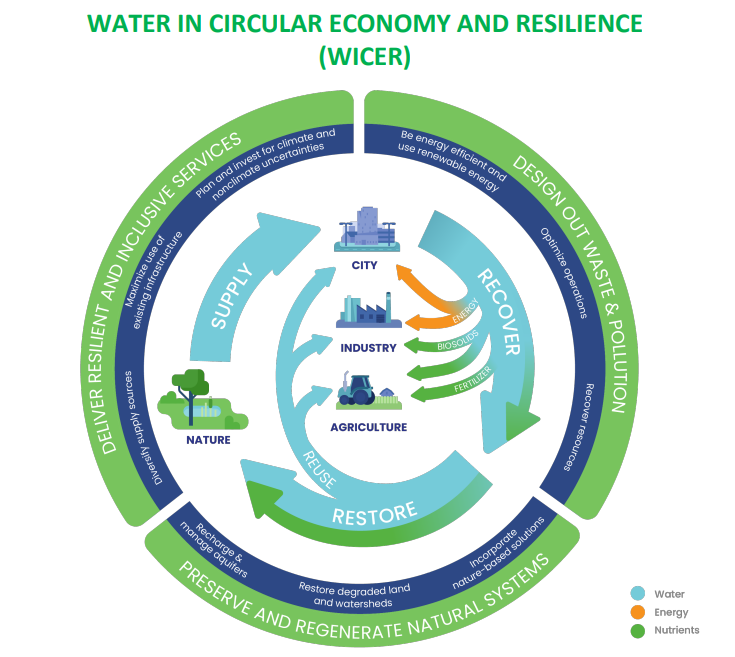
Circular Business Models: How Companies Can Apply Circular Economy Principles in Water Stewardship
La economía circular aplicada al agua implica repensar cómo usamos este recurso y cómo puede seguir cumpliendo diferentes funciones dentro de un sistema cerrado, sin ser desperdiciado. En lugar de tratar al agua como un recurso que simplemente fluye de una fuente a un proceso y luego se descarta, la economía circular del agua promueve su uso continuo y reutilización, con el mismo o diferente propósito, a lo largo de su ciclo de vida. Este enfoque permite a las empresas conservar agua, mejorar la calidad del ecosistema y reducir el impacto ambiental de sus operaciones, alineando la circularidad con una estrategia corporativa de sostenibilidad.
Nature-based solutions are definitely gaining ground as a key approach in sustainable water management. These solutions harness natural ecosystem processes to manage and protect water resources efficiently. Some examples that blend nature-based solutions with the circular economy include:
- Wetland restoration or the creation of artificial wetlands,
- Planting vegetation in strategic areas,
- Creating green infrastructures, such as urban forests or rainwater channeling and storage systems.
However, one of the most successful nature-based solutions showing the best results is the implementation of optimized irrigation techniques. These precision irrigation systems allow for more efficient water use in agriculture, ensuring each drop is used by the crop at the right moment, reducing waste, and adjusting the water volume to the plant’s needs, preventing stress and improving its growth and production. At Agrow, we use precise irrigation data to optimize water use across different sectors, allowing agricultural companies to better manage their water footprint and adopt sustainable practices that make a difference. This not only reduces dependence on external water sources but also contributes to the health of the local ecosystem. Furthermore, the water circularity paradigm is at the core of Agrow, as we understand that water is a unique resource, and companies can make great efforts not only to optimize water use in their operations but also to replenish their water footprint through irrigation optimization in agriculture.
Reducing the Water Footprint through Circularity
A company's water footprint considers the direct component attributed to all water consumed in an internal process or across the entire site (blue and/or green water footprint), as well as the water necessary to dilute the contaminated volume generated in this process or site (grey water footprint). However, it is also relevant to measure the indirect water footprint. This indirect component considers the water needed to produce a good or service along its supply chain. It takes into account water consumption and degradation from primary inputs, energy use, and other components necessary for the operation of the site. Understanding the water footprint, its composition, and origin is crucial when adopting the circular water economy, as this information allows companies to significantly reduce their consumption.
Through nature-based strategies such as:
- creating a wetland at the exit of a non-toxic discharge, a site can reduce, especially, the grey water footprint by naturally treating effluent water, which is purified by nutrient absorption by the wetland.
- green infrastructures, such as replacing pavement with a surface that can infiltrate rainwater, allows for underground channeling of this water to city water intakes, which can be reused in processes such as irrigation, thereby reducing the blue water footprint of crops.
Al aplicar tecnologías de reciclaje de aguas residuales, riego eficiente y otras soluciones asociadas con la economía circular,las empresas pueden lograr una reducción significativa de su huella hídrica. Esto no solo reduce la cantidad de agua extraída de los recursos naturales, sino que también mejora la eficiencia con la que se utiliza el agua dentro de los procesos productivos. Esto contribuye al ahorro de agua, la mejora de la calidad de los recursos hídricos y la conservación de los ecosistemas acuáticos, beneficiando tanto a las empresas como a las comunidades locales y, por supuesto, al planeta.
Challenges and Opportunities for Companies Interested in Leading Water Sustainability
While implementing the circular water economy paradigm may represent a structural challenge for a company, its implementation offers numerous and significant benefits. The implementation of the circular water economy can improve operational efficiency and reduce long-term costs by decreasing dependence on external water sources and competition for the resource in areas facing water scarcity or limited access to potable water. It also enhances the resilience of a population, city, or region to extreme drought events or issues accessing quality water, thus maintaining a more stable life ecosystem, less dependent on climate conditions. Additionally, companies that adopt these practices meet the current market demands, which increasingly call for businesses to lead in sustainability. As more companies adopt circular solutions, such as those offered by Agrow to measure and optimize water use, a positive impact is generated on global water sustainability.

Conclusion
We are aware that a water paradigm shift is as challenging as it is necessary. The circular water economy is an essential approach for companies to become agents of change for water resource preservation and contribute to the regeneration of aquatic ecosystems. Adopting this approach not only improves companies' operational efficiency but also positions them as leaders in water sustainability. Efficient water use is a long-term investment that benefits the planet, communities, and companies' competitiveness. Companies that aim to be leaders in water sustainability understand that the shift from a linear to a circular water model is one of the major steps to take.
Now, find out the latest news from Agrow!
¡Ahora sí, descubre las últimas novedades de Agrow!
📣 We have announced a new project to address water scarcity and water efficiency in Aragón, Spain! Together with Amazon Web Services (AWS), we are proud of this great challenge ahead, a major water replenishment project that will make a difference in the region. Read more in the post by Clare Biddle, EMEA Water Lead at AWS
🗞️Agrow in the news! Learn more about our success story in optimizing water use through a major offset project in the Río Tajo area in this article from Diario SUR.
🌎Happy World Water Day! Learn what inspires our team to dedicate every day to preserving water worldwide. Watch the video here.
Thank you for reading! See you in the next edition of Drops a Month, where we will continue exploring the latest trends in water sustainability. See you soon! 🌍💧