
Análisis Radicular y Foliar con IA
Para productores agrícolas, asesores agronómicos y empresas de bioestimulantes y fitosanitarios
Challenges in crop monitoring
Objectively verify and understand the impact of various treatments, such as fertilizers or biostimulants, on plant canopy and root system development.
Our AI-based solution
Accurately and consistently quantify the physiological traits of your plants, simplifying measurements and enabling scalable comparisons.
Objective quantification
New data availability
Homogeneity of the analysis
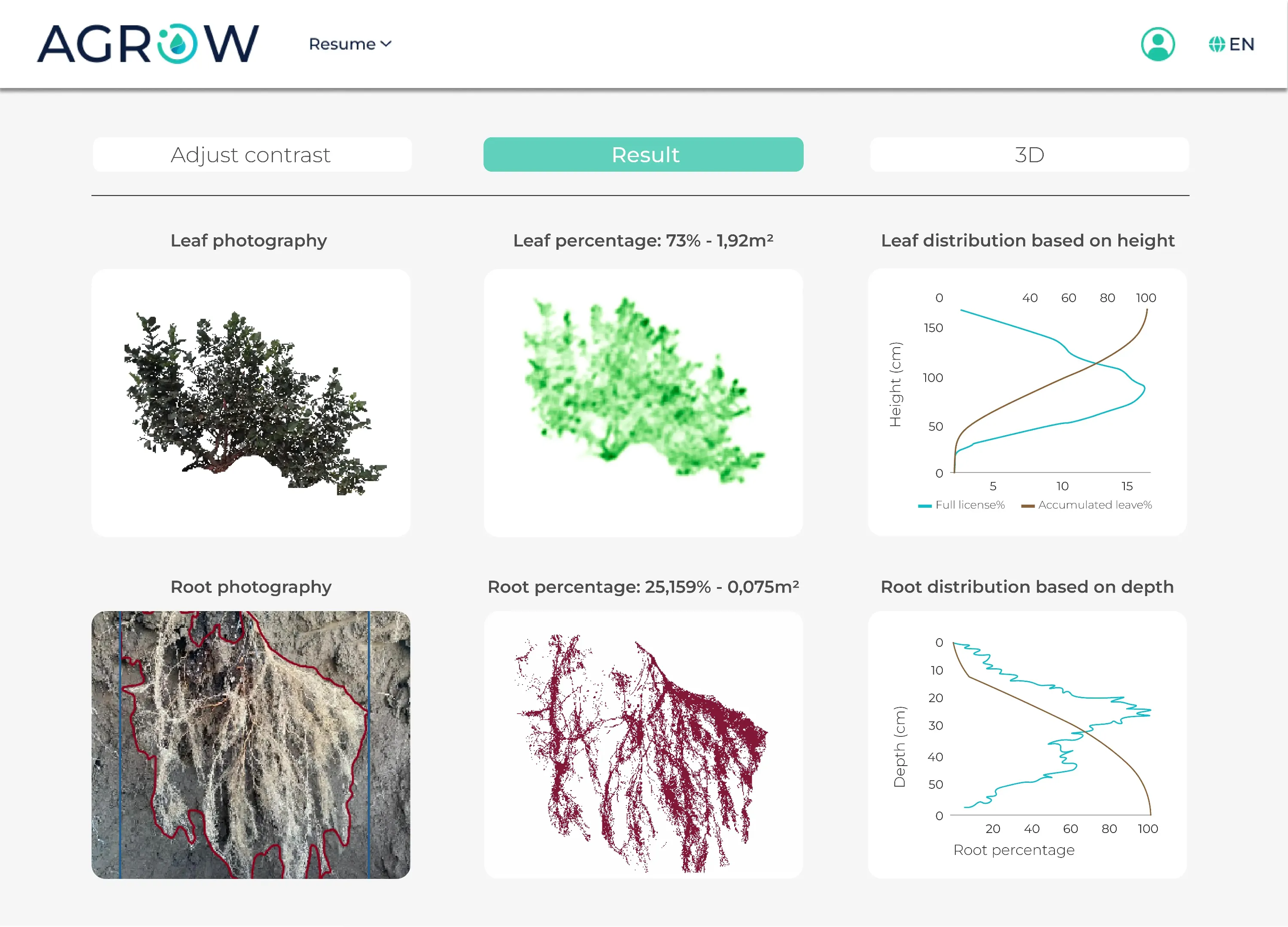
- Quantify with your phone
- Easily analyze plants using AI
- Verify effects of fertilizers and treatments
- Standardize plant physiology comparisons
Servicios de Visión Artificial para
el Análisis de Cultivos
Detección y Análisis Radicular con IA
Medimos con precisión el desarrollo radicular de la planta, cuantificando el crecimiento de las raíces y el follaje mediante visión artificial para optimizar el manejo de cultivos y evaluar la efectividad de tratamientos.
Análisis de Efectividad de Fertilizantes y Bioestimulantes
Evaluamos el impacto de fertilizantes, bioestimulantes y fitosanitarios mediante detección de plantas con IA, cuantificando mejoras en la salud radicular y el rendimiento del cultivo con datos objetivos y reproducibles.
Reconstrucción 3D de Raíces y Estructuras Vegetales
Generamos modelos 3D de raíces y estructuras vegetales a partir de imágenes capturadas con el móvil, permitiendo un análisis volumétrico preciso del sistema radicular sin necesidad de laboratorio.
Other water solutions from Agrow
- Read more
farmers and agronomical advisors
Irrigation optimization in agriculture
Water replenishment projects for companies aiming to reach their Water Stewardship goals
- Read more
For water experts
Water Stewardship
- Read more
Water efficiency solutions
Collective action projects
Preguntas Frecuentes sobre Visión Artificial en Agricultura
Do I need any special device to use AI in my crops?
No, this technology is designed to provide easy access to relevant data and detailed crop traits using just the camera on your mobile phone or a photographic camera.
Is there a protocol or methodology for taking photos?
Yes, for standardised and higher-quality results, we recommend a straightforward protocol and guidance for taking photos. This protocol should be followed for both leaf area and root systems.
What are the advantages and limitations of computer vision in crops?
Unlike other market solutions, this technology doesn't require controlled conditions or specialized devices. It simplifies adoption, making it practical for real-world agricultural applications beyond research settings.
Additionally, its accuracy makes it ideal for R&D departments seeking to quantify and evaluate results from various treatments and experimental testing with ease.
Which crops is computer vision compatible with? Which ones have we worked with?
We have successfully applied our technology to a wide range of crops, including blackberries, avocados, grapes, citrus, sweet cherries, and hazelnuts. Additionally, we have implemented it in annual crops such as maize, canola, wheat, sunflower, and beans.
Is the root analysis method invasive?
For leaf area analysis, our method is non-invasive. However, quantifying root systems requires visualizing the roots to capture images. Depending on the sample size, the following techniques can be implemented:
• Soil pit
• Pot
• Rhizotron
• Clean roots
Can computer vision be combined with automated irrigation technology?
Indeed, all of Agrow's technology is designed to work together and add value to each other. For the irrigation recommendation system, our artificial vision tools enable:
• Knowing the LAI or actual leaf area, which allows us to further adjust the transpiration component of the plants.
• Identify the distribution of feeder roots throughout the soil profile, enabling us to objectively adjust the available water for plants and optimize irrigation based on water demand.
• Model root growth at each phenological stage using real data.

