


Water sustainability has become a strategic priority for companies looking to leave a positive legacy on the planet. In this journey, the ability to measure the impact of each action is key to progressing with certainty and generating real value. la capacidad de medir el impacto de cada acción es clave para avanzar con certeza y generar valor real.
Volumetric Water Benefit Accounting (VWBA) offers organizations a robust and validated methodology for quantifying volumetric water benefits (VWB) associated with water resource management projects and activities. At Agrow, we integrate this methodology into our water replenishment strategies to ensure that each intervention has a clear, localized, and measurable purpose.
What is VWBA?
Developed by the World Resources Institute in collaboration with LimnoTech, Quantis, and Valuing Nature, VWBA provides a framework to calculate the volume of water saved by activities that positively modify local hydrology or resource usage.
This approach enables companies to:
- Understand the ireal impact i of their water sustainability initiatives.
- Prioritize actions aligned with the specific challenges of each watershed.
- Attribute quantifiable results to their corporate water stewardship strategies, in line with goals such as SDG 6: Clean Water and Sanitation.
The Three Stages of VWBA: A Structure for Measurable Impact
VWBA proposes a three-stage process that guides organizations in implementing projects with tangible water impact:
1. Understand Water Challenges and Local Context
Each watershed has its own reality, risks, and priorities. The first step is to analyze the specific water threat of the territory,considering factors such as quality, availability, demand, access, and the condition of aquatic ecosystems. This deep understanding forms the foundation for defining actions that generate real benefits.
2. Define Activities, Projects, and Strategic Allies
Once the challenge is identified, the most appropriate activities to address it are defined. This is where water replenishment projects, one of Agrow's key focus areas, come into play. These projects can include everything from optimizing water use in irrigation with artificial intelligence to solutions that restore ecosystems or improve community access to the resource. The right collaborators are also selected to ensure effective, contextual, and collective impact.
3. Collect Data and Calculate Volumetric Benefit
Finally, the necessary data is gathered, and the corresponding calculation method is applied based on the type of activity and proposed objective. VWBA defines specific indicators for each type of measurement, ensuring that the data is relevant and aligned with each goal and activity. However, VWBA does not guarantee traceability. Having traceability and clear evidence supporting these indicators is essential to demonstrate that water savings have a real and verifiable impact on the watershed. In this process, technological solutions like those from Agrow help transform data into concrete evidence, ensuring that every liter saved translates into positive and measurable environmental impact.
The Essence of VWBA: Action with Local and Social Meaning
VWBA is based on core principles that make it a reliable tool aligned with best global practices. Its essence lies in. aligning each activity with the real needs of the territory, adapting it to the social context, respecting human rights, fostering collective governance, and evaluating its impacts in a holistic way..
This approach ensures that each project not only generates measurable benefits but also has a substantial impact on the water challenges faced by the territory and contributes to the water resilience of the ecosystems and communities involved..
What Types of Activities Can Generate Volumetric Benefits?
VWBA covers a wide range of objectives that allow justifying and measuring activities related to the efficient and regenerative use of water, such as:
- Improving water quality by reducing pollution from localized or diffuse sources.
- Reducing water demand in productive activities.
- Increasing social resilience by ensuring more equitable and secure access to the resource.
- Preserving and restoring water ecosystems.
- Maintaining or recovering the water balance in a watershed.
Each of these objectives can be quantified using specific methods defined by VWBA, based on the most relevant indicator for evaluating the activity's impact. VWBA suggests possible activities that generate a positive impact on water and allow for the quantification of water benefits. These include actions such as aquifer recharge, reducing demand by improving efficiency and minimizing losses, improving water quality by controlling localized pollutant losses (e.g., industrial effluents or gray water) or diffuse losses (e.g., fertilizer use in agriculture), replacing high-impact water sources, or restoring ecosystems, among others.
At Agrow, we carefully select the most appropriate method for each case, ensuring that the measurement accurately reflects the value generated by each intervention.
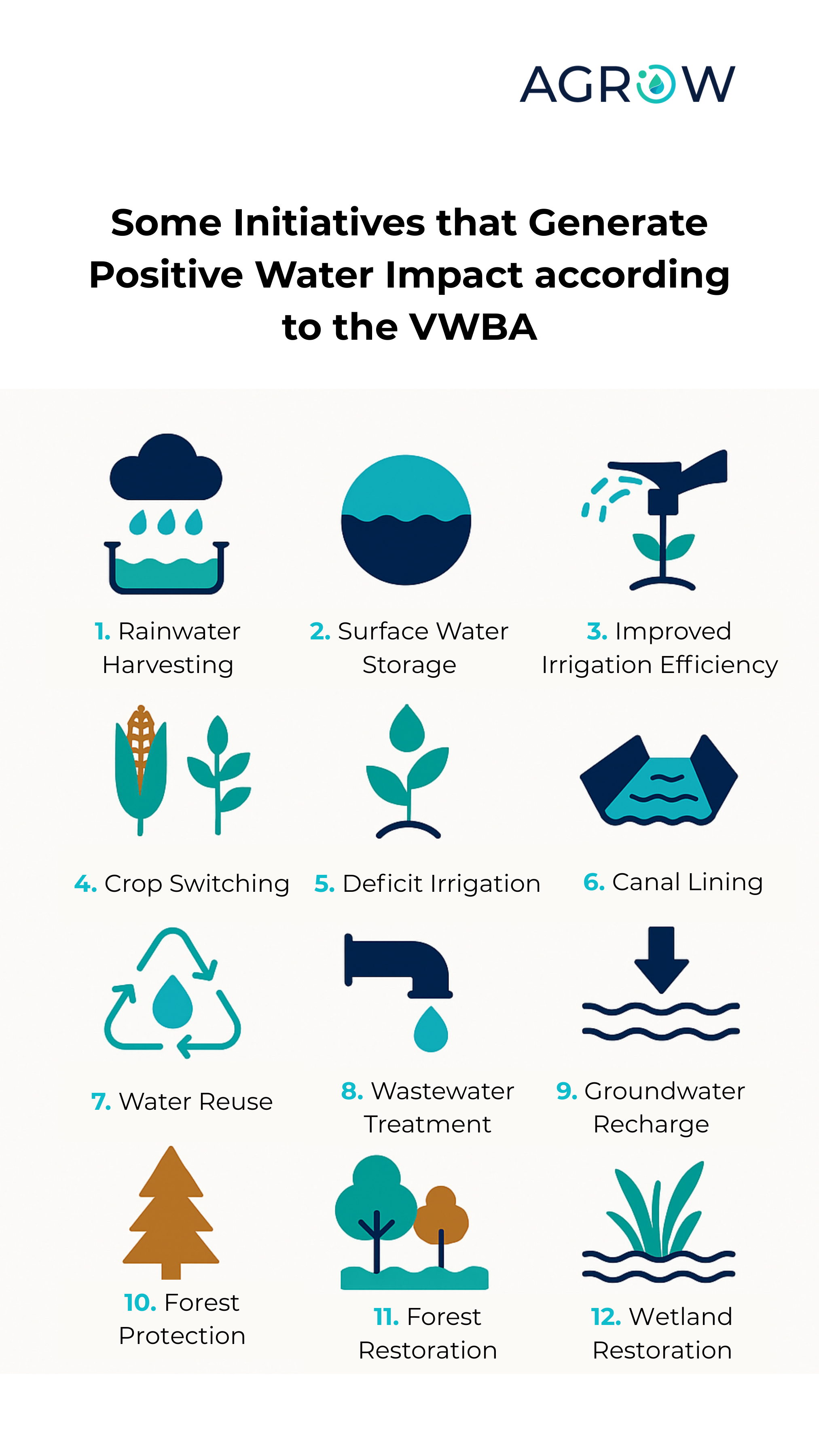
How We Apply It at Agrow
At Agrow, we thoroughly study each case to understand the local water context and define the best replenishment strategy. We use our artificial intelligence-based technology to optimize water use in agricultural irrigation and fertilizer usage. This is how these savings are associated with measurable projects aligned with the VWBA methodology.
Correctly categorizing water challenges in each watershed allows us to identify the most effective activities and select the calculation method that best reflects their impact. In this way, we help companies replenish their water footprint with data-driven actions aligned with their sustainability goals, and with real environmental and social impact.
Measuring to Transform
VWBA provides corporations with a clear path to transform their water vision into measurable impact. At Agrow, we integrate it as a central part of our proposition: helping companies lead the future of water sustainability, with technology, local knowledge, and a genuine commitment to the planet.